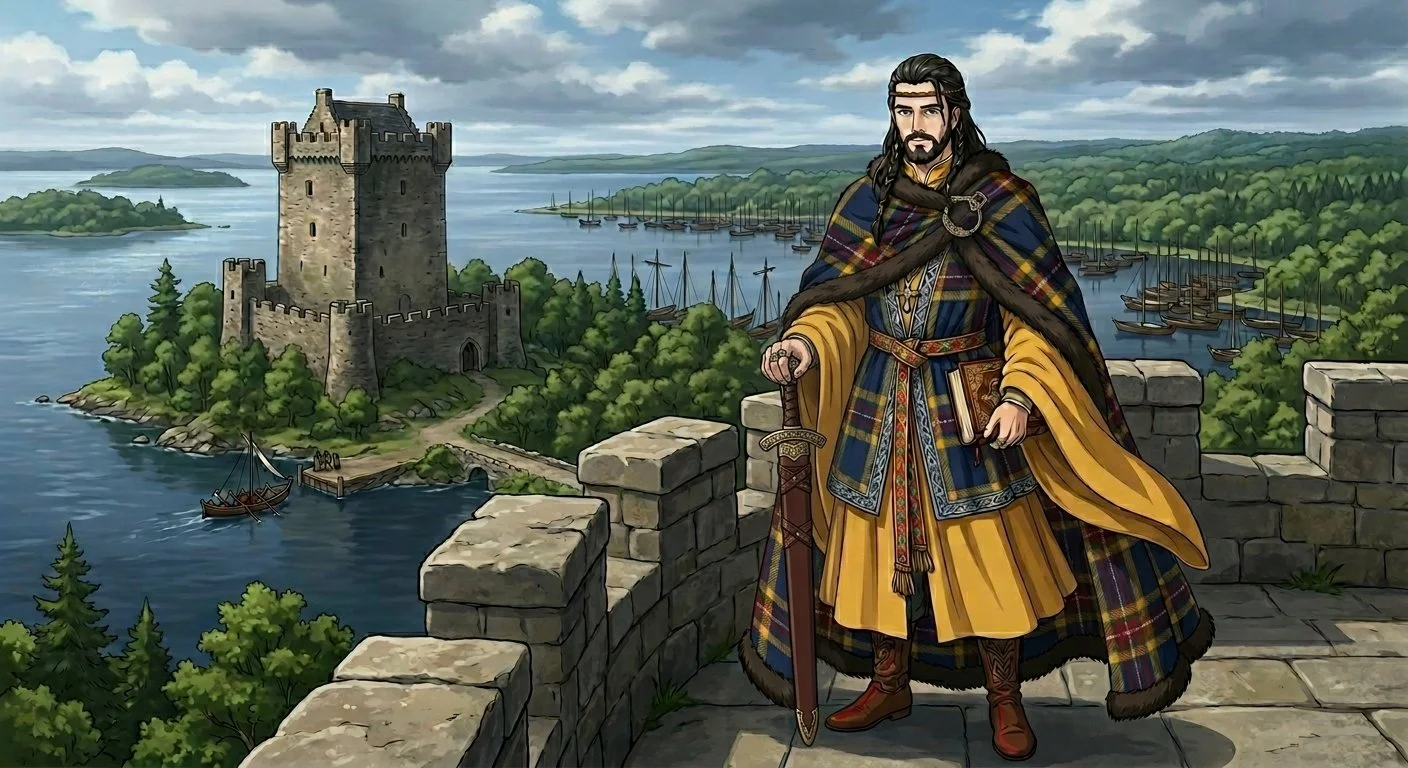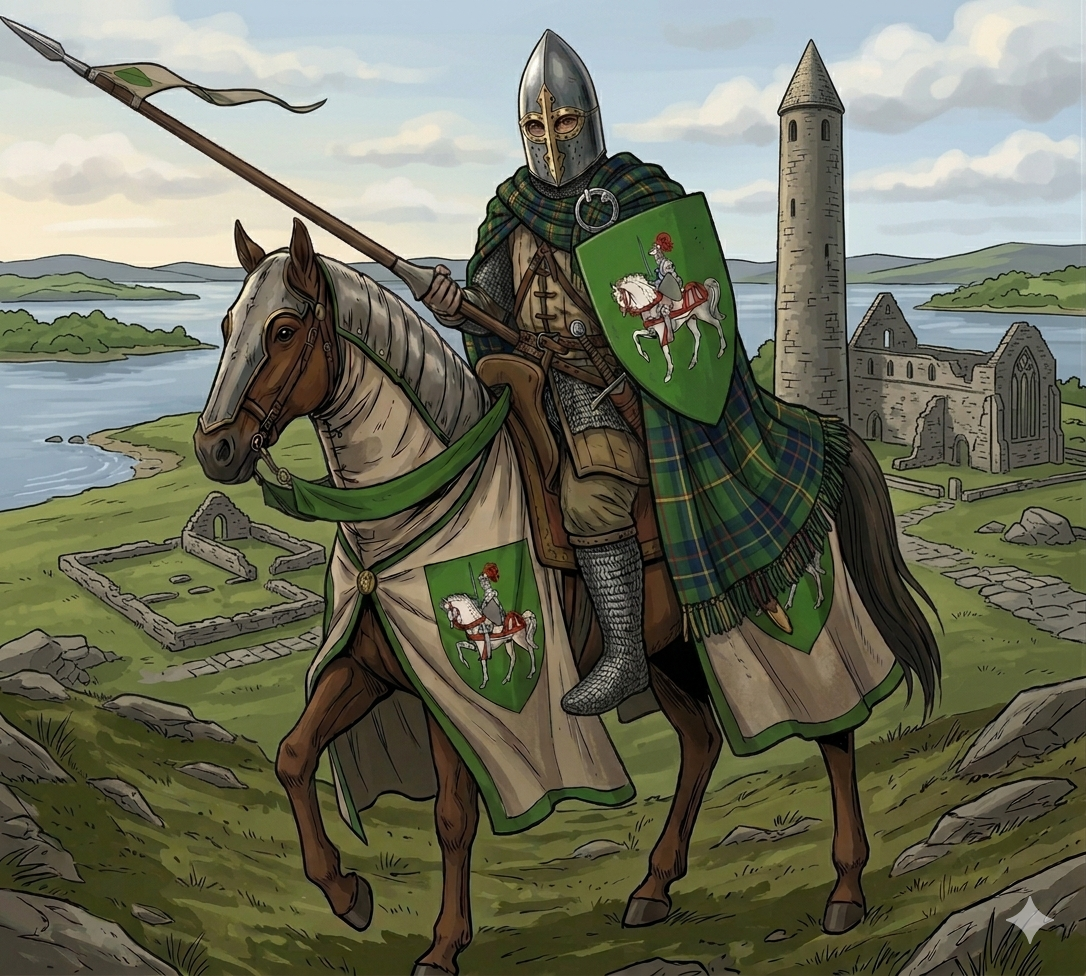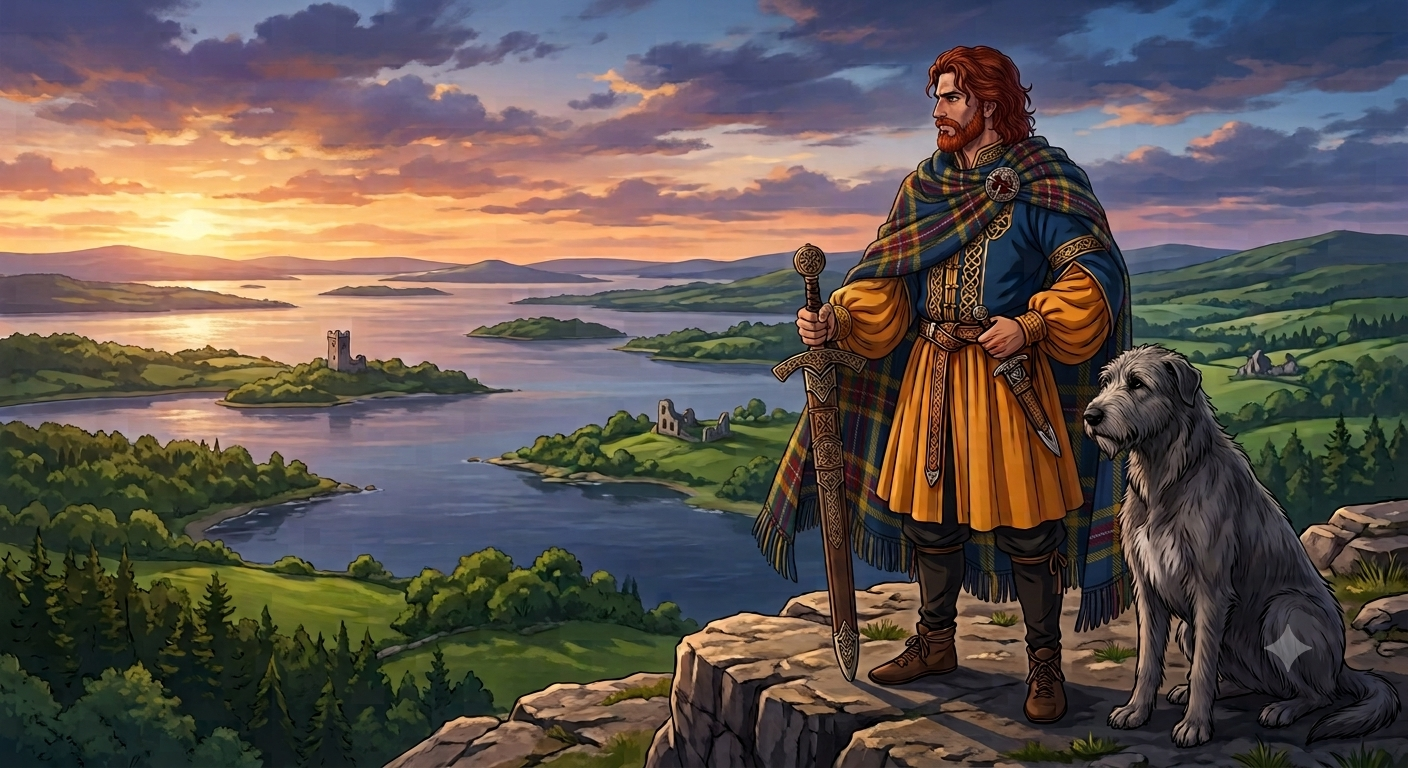
From the Menapii to the Fir Manach an identity is born.
1. The Menapii in the Gallic Wars
The Menapii were a powerful Belgic tribe situated in the Rhine-Meuse-Scheldt delta (modern-day Belgium and the Netherlands). Julius Caesar, in his Commentarii de Bello Gallico, described them as a people who refused to submit to Roman hegemony.
Guerilla Tactics: Unlike other Gauls who met Caesar in open battle, the Menapii retreated into their dense forests and vast marshes.
Naval Prowess: They were a maritime culture with strong trade links across the North Sea, making them difficult for the Roman legions to corner.
Resistance: They were among the last tribes to be "pacified," only succumbing after Caesar’s lieutenants conducted scorched-earth campaigns in 54–53 BC.
2. Migration to Britannia and Hibernia
As Roman pressure intensified, segments of the Menapii elite likely utilized their naval networks to relocate.
Ptolemy’s Map: The most reliable evidence for their arrival in Ireland comes from the 2nd-century geographer Claudius Ptolemy. On his map of Ireland, he identifies a tribe called the Manapi (Μανάπιοι) located on the southeastern coast, near modern-day Wexford/Wicklow.
The Leinster Settlement: Archaeological evidence of Roman-style burials and high-status goods in Leinster suggests a "Belgic" influence or a group of settlers who maintained trade links with the Roman world.
3. Displacement of the Ulaid and the Kingdom of Airgíalla
Over centuries, the Menapii (now known in Old Irish as the Manaig) expanded northward. This movement coincided with the decline of the Ulaid (the ancient rulers of Ulster based at Emain Macha).
The Expansion: As the Ulaid were pushed toward the northeast (modern Antrim and Down), the Manaig and their allies occupied the central and southern parts of Ulster.
4. The Saga of the Three Collas
The legendary account of this migration is found in the Saga of the Three Collas (Colla Uais, Colla Menn, and Colla Foithri).
The Myth: In the 4th century, the Three Collas allegedly led an army from Connacht at the behest of the High King to destroy Emain Macha and seize Ulster for themselves.
The "Grain of Truth": Historians like T.F. O'Rahilly (in Early Irish History and Mythology) argue that the Collas represent the historical expansion of the Belgic/Menapian groups. The name Colla Menn is often specifically linked to the Menapii/Manaig lineage.
5. The Fir Manach and County Fermanagh
As the Manaig settled in the lake country of the north, they became known as the Fir Manach ("Men of the Manapi/Manaig").
The County: This tribal name survived the transition into the modern era, directly giving its name to County Fermanagh (Contae Fhear Manach).
Legacy: Unlike many other tribes whose names vanished, the Fir Manach maintained a distinct identity through the medieval period, eventually ruled by the Maguire dynasty, who claimed descent from these ancient maritime ancestors.
Fermanagh’s Viking History and the Maguires beginnings.
The "Viking Age" in Ireland strictly spans from 795 AD to 1014 AD (ending with the Battle of Clontarf). To understand the Maguires during this time, it is vital to distinguish between the territory of Fermanagh and the Maguire surname, which did not become a ruling dynasty until centuries later.
1. The Historical Timeline: Ancestors, not "Maguires"
During the Viking Age, the people who would later become the Maguire clan were part of the Airgíalla (Oriel) tribal confederation. The surname Mag Uidhir (Maguire) did not exist as a political entity in the 9th or 10th centuries.
The Rulers: During this era, Fermanagh was ruled by the Ó hÉicnigh (Heaney), Ó Maolruanaidh (Mulrooney), and Ó Dubhdara (Dara) families.
The Ancestor: The clan takes its name from Uidhir, a 10th-century lord of the Fir Manach. While he lived toward the end of the Viking Age, he was a local chieftain, not yet the "King of Fermanagh."
2. Viking Raids on Lough Erne (820s–840s).
The most significant "Viking history" for the Maguire ancestors involves the defence of the Erne waterways. Vikings utilized Lough Erne as a highway into the heart of Ulster.
The Raids of 837 AD: The Annals of Ulster record that "all the churches of Loch Erne... were destroyed by the gentiles [Vikings]."
The Burning of Devenish: The famous monastic site of Devenish Island was raided in 822 AD and again in 837 AD. The ancestors of the Maguires—the Uí Chrimthainn—would have been the ones fighting these hit-and-run naval parties.
Turgesius (Thorgils): Legend says the Viking warlord Turgesius personally led fleets up the Erne. While some of his exploits are semi-mythical, the archaeological evidence of Viking "longphorts" (ship camps) in the midlands suggests a heavy presence near Fermanagh.
Turgesius (identified in Old Norse as Thorgils) is one of the most infamous and debated figures of the Viking Age in Ireland. Most of Thorgils' "victories" were raids on monastic centers rather than set-piece field battles. His career is roughly dated between 832 and 845.
. The "Reign of Terror" (832–845 AD).
Turgesius arrived with a massive fleet (reportedly 120 ships) and implemented a "cordon" strategy, placing fleets on major waterways to control the interior.
The Capture of Armagh (832): He expelled the inhabitants and usurped the Abbacy of Armagh, the religious capital of Ireland. This was a direct strike at the heart of the Airgíalla territory and the Uí Néill religious prestige.
The High Altar of Clonmacnoise: His wife, Ota, is famously said to have performed pagan "prophetic" rites from the high altar of the great monastery of Clonmacnoise while Turgesius ruled from a fort on Lough Ree.
The Founding of Dublin (841): He is traditionally credited with establishing the longphort (ship fortress) at Dubh Linn, though contemporary archaeology suggests this was a collective Viking effort rather than the work of one man.
. The Death of Turgesius.
His death in 845 AD is one of the most famous stories in medieval Irish history, existing in two versions: the dry historical fact and the colorful legend.
Historical Fact: The Annals of Ulster (the most reliable source) simply state that Turgesius was captured by Máel Sechnaill mac Máele Ruanaid (King of Meath) and subsequently drowned in Lough Owel (Co. Westmeath).
The Legend (The "Beauty" Trap): Later accounts (like those of Giraldus Cambrensis) claim that Turgesius fell in love with Máel Sechnaill’s daughter. The King agreed to send her to Turgesius's island fortress with 15 "handmaidens." These were 15 beardless young warriors disguised in women's clothing. Once inside the fortress, they drew hidden daggers, seized Turgesius, and slaughtered his guard.
3. Clans Involved and the Airgíalla Role
The resistance against Turgesius was not a single "Irish" army but a series of actions by powerful regional dynasties.
Clann Cholmáin (Southern Uí Néill): Led by Máel Sechnaill. They were the primary architects of his downfall. By killing Turgesius, Máel Sechnaill cemented his path to becoming High King of Ireland.
Cenél nEógain (Northern Uí Néill): Led by Niall Caille. They fought a massive battle against Turgesius's forces at Moynith in 843 AD, significantly weakening the Viking grip on Ulster before his eventual capture.
The Airgíalla (Oriel):
During this period, the Airgíalla were a "satellite" confederation under the protection/dominion of the Northern Uí Néill.
Their Role: They were the primary victims and defenders of Armagh. Because Armagh was located in Airgíalla territory, their lords (the ancestors of the Maguires and McMahons) were the ones physically displaced when Turgesius took the city. They fought as part of the Northern Uí Néill forces in the battles that eventually drove the Vikings back to their coastal bases.
The relationship between the Gaels (the native Celtic people of Ireland and Scotland) and the Norse (Viking settlers from Scandinavia) was one of the most transformative "cultural collisions" in European history. It began with violent raiding but evolved into a deeply integrated, hybrid society known as the Norse-Gaels.
The timeline of their relationship can be broken down into three distinct phases.
1. The Era of Conflict (c. 795 – 840 AD)
Initially, the relationship was purely predatory. The Vikings (predominantly from Norway) targeted the soft underbelly of Gaelic society: the wealthy, coastal monasteries.
Tactics: Small-scale hit-and-run raids using longships.
Impact: The Gaels viewed the Norse as "heathens" and "foreigners." The Irish annals of this time are filled with entries describing the burning of churches and the taking of slaves.
2. The Era of Settlement & Alliance (c. 840 – 950 AD)
The Norse began staying in Ireland year-round, building fortified ship camps called longphorts (like the one that became Dublin). This led to a shift from raiding to political maneuvering.
Political Pawns: Irish kings, who were constantly at war with each other, began hiring Norse mercenaries to fight their Gaelic rivals.
Intermarriage: Dynastic marriages became common. Norse leaders took Gaelic wives, and vice versa, to secure land and peace.
The Gall-Ghaidheil: By the mid-9th century, a new group emerged called the Gall-Ghaidheil (literally "Foreigner-Gaels"). These were individuals of mixed ancestry who often spoke both Old Norse and Old Irish.
3. The completion of hybrid society (c. 950 – 1169 AD)
By this stage, the Norse in Ireland (often called Hiberno-Norse) were no longer "outsiders." They were essentially a new sub-set of the Irish population.
Religious Shift: The Norse abandoned their pagan gods and converted to Christianity, often becoming major patrons of the very monasteries their ancestors had robbed.
Urbanization: The Norse founded Ireland's first cities (Dublin, Cork, Limerick, Waterford, Wexford). The Gaels remained largely rural and pastoral, creating a symbiotic relationship where the Norse provided trade and the Gaels provided agricultural goods.
The Ostmen: By the time the Crambo-Normans arrived in 1169, the urban Norse called themselves Ostmen ("East-men"). They were physically and culturally indistinguishable from the native Gaels except for their town-dwelling lifestyle.
The 10th century was a transformative era for the Fir Manach ("Men of Monach"). During this time, they transitioned from being a peripheral tribe within a larger empire to establishing the sovereign Kingdom of Fermanagh.
1. The Geopolitical Break: From Uí Chremthainn to Fermanagh
To understand the "break," you must look at the internal collapse of the Airgíalla (Oriel) federation.
The Original Structure: In the early medieval period, the Fir Manach were part of the Uí Chremthainn, one of the three core "states" of Airgíalla.
The 10th Century Shift: By the mid-900s, the over-kingdom of Airgíalla began to fragment. The northern dynasties (like the O'Neills) and the southern ones (like the O'Connors) were constantly squeezing the Airgíalla.
Independence: The Fir Manach utilized their "lake fortress" geography (Lough Erne) to pull away from the central Airgíalla authority. They stopped acting as a mere sub-unit and began appointing their own Kings of Fermanagh.
2. The First Sovereign Kings (Pre-Maguire)
It is a common misconception that the Maguires were the ones who broke from Airgíalla. In reality, the Ó hÉicnigh (Heaney) and Ó Dubhdara (Darragh) families were the architects of Fermanagh’s independence.
Cathal Ó Dubhdara (died 1009): He is the first ruler recorded in the Annals who is clearly recognized as a distinct "King of Fermanagh." His reign at the end of the 10th century marks the official birth of the independent lordship.
The Airgíalla Heritage: Even after breaking away, these kings claimed descent from the Three Collas (the mythical founders of Airgíalla). This was a "political cunning" move: they kept the prestigious royal bloodline but refused to pay tribute to the central Airgíalla over-king.
3. The "Seven Tuatha" Strategy
The Fir Manach consolidated their independence by organizing the region into seven "tuatha" (baronies/territories). By the late 10th century, the King of Fermanagh was often titled the "Lord of the Seven Tuaths." This decentralized but unified structure made Fermanagh incredibly difficult to conquer. An invader couldn't just capture one city; they had to subdue seven distinct, water-protected territories.
The "break" was less of a violent revolution and more of a geographical secession. By the year 1000, the Fir Manach had successfully carved out a "buffer state" that was no longer an Airgíalla province, but a sovereign kingdom. This independent foundation is exactly what allowed the Maguires to step in three centuries later and build one of the most powerful Gaelic lordships in Irish history.
Irish Head Hunting.
In Gaelic and broader Celtic history, "headhunting" was a ritualized practice rooted in the belief that the head was the seat of the soul. While it is often associated with the Gauls of continental Europe, it was a central feature of Iron Age Gaelic (Irish and Scottish) warrior culture and remained present in Irish literature and annals well into the medieval period.
The Cultural & Spiritual Significance
For the Gaels, taking a head was not merely an act of brutality; it was a spiritual and social necessity.
Seat of the Soul: The Gaels believed the head contained a person's life force, wisdom, and "soul matter." By taking the head, a warrior supposedly captured the strength and spirit of their enemy.
The "Cult of the Head": While historians’ debate if there was a formal "religion" dedicated to heads, the archaeological and literary evidence for head veneration is immense.
Proof of Valor: Heads served as physical receipts of victory. The 1st-century BC historian Diodorus Siculus recorded that Celts would refuse to sell these trophies even for their weight in gold.
Headhunting in Gaelic Mythology
The Irish sagas are filled with references to this practice, often blending history with the supernatural:
The Morrígan’s Acorns: In Irish myth, severed heads were poetically called "the acorns of Macha" (one of the aspects of the war goddess, the Morrígan).
Talking Heads: The story of Conaire Mór features his severed head drinking water and reciting poetry. This reflects the belief that the head retained consciousness after death.
Cú Chulainn: The most famous Gaelic hero is frequently described returning from battle with heads dangling from his chariot or belt as trophies of his prowess.
Common Misconceptions
"It was just mindless violence":False. It was a highly regulated social ritual. Rules of hospitality and "single combat" often dictated whose head could be taken and how it was to be treated.
"They were cannibals":Unlikely. While some Roman sources claimed Celts were cannibals to make them seem "barbaric," there is very little archaeological evidence of dietary cannibalism among the Gaels. It was about trophies, not food.
"Only enemies were beheaded":False. Sometimes the heads of beloved leaders were kept to protect the tribe or to allow the leader to "consult" with the living from the Otherworld.
The Evolution of Celtic and Gaelic War Music.
The visceral tradition of Gaelic war piping is not a historical anomaly. It is the continuation of a millennia-old sonic lineage designed for psychological warfare, tribal cohesion, and communication on the battlefield. This sonic arc stretches from ancient Iron Age continent-spanning Celtic tribes down through medieval Gaelic lordships, culminating in the defiant tunes of the great ruling families of Ulster. Long before the bagpipe echoed across the glens, the primary acoustic weapon of the Celts was the carnyx (often phonetically rendered or adapted in specific regional contexts as the cynxe). This formidable Iron Age wind instrument was a massive, six-foot-tall bronze trumpet bent in a stretched "S" shape, terminating in a flared bell sculpted to look like the gaping jaws of a wild boar or a dragon. The carnyx was held vertically so its bell towered over the heads of the warriors, allowing the sound to travel immense distances over the din of battle. The ancient Greek historian Polybius noted the sheer terror it induced, describing a "harsh sound which suits the tumult of war" that, when combined with the shouting of the army, created a maddening, paralyzing wall of noise. This specific method of sonic intimidation was passed down through generations of distinct Celtic tribes, bridging continental Europe with the British Isles and Isle of Hibernia. The Menapii: A powerful Belgic-Celtic confederation located around the Rhine and Scheldt rivers, the Menapii were famous for their fierce resistance against Julius Caesar. They utilized dense forests and marshlands to wage guerrilla warfare, heavily relying on horn-calls and raw acoustic signals to coordinate scattered ambushes across treacherous terrain. The Fir Manach: As Celtic populations migrated and fused, these ancestral martial traditions traveled across the Irish Sea. The historical movement of peoples links the continental tribes to the Fir Manach (the "Men of Manach"), an early tribal grouping that settled in Ireland and ultimately gave their name to County Fermanagh. With the Fir Manach, the ancient concept of using loud, continuous wind instruments to terrify enemies and rally troops became deeply rooted in the soil of Ulster. As the Bronze and Iron Ages yielded to the Medieval period, the cumbersome, straight-blast mechanics of the carnyx evolved into a more sustainable and relentless musical weapon: the Píob Mór (the Great Irish Warpipe). Unlike the modern Scottish Highland bagpipe which typically utilizes three drones, the medieval Irish warpipe generally featured two drones extending from a leather bag. This structural development changed warfare completely: where a horn player had to stop to breathe, a warpiper could utilize the air reserve in the bag to maintain an unbroken, continuous wall of sound. In the Gaelic Lordship system, the warpiper held a position of immense privilege, ranking alongside bards and brehons (judges). Pipers marched directly at the head of the Gallóglaigh (Gallowglass) and Ceithern (Kearn) forces, using specific melodic keys and piercing high notes to slice through the chaotic clashes of iron and steel. The direct lineage of this martial music is perfectly encapsulated by the Maguire Clan, the historic rulers of Fermanagh (the land of the Fir Manach) from the 13th to the 17th centuries. As the Tudor conquest of Ireland accelerated in the late 16th and early 17th centuries, the Maguires stood as one of the final bastions of the old Gaelic order. During the Nine Years' War, Hugh Maguire, Lord of Fermanagh, led brilliant cavalry campaigns against Elizabethan forces. To command these forces, the clan relied heavily on Maguire’s March (sometimes known as The Maguire's Clan March or associated with the rhythm of Maguire's Kick). Maguire's March is characterized by a driving, syncopated rhythm. When adapted to the Píob Mór, its sharp, repetitive intervals served a dual purpose: it kept a fast, aggressive marching pace for the infantry while triggering deep-seated psychological panic in English forces, who wrote extensively in state papers about the "vile skirling" that preceded bloody Irish ambushes. When the Gaelic order finally collapsed after the Flight of the Earls, the Píob Mór was heavily suppressed, yet the music survived. Maguire's March was kept alive by being passed down through the hidden piping and fiddling traditions of Ulster, eventually transcribed into historical collections like those of William Walsh and Charles Villiers Stanford. The journey from the boar-headed carnyx of the Menapii to the double-drone Píob Mór playing Maguire's March represents an unbroken chain of human expression. The Gaelic war pipe did not invent the terrifying, adrenaline-pumping soundtrack of Irish warfare; it simply refined an ancient, elemental Celtic roar that had been echoing across battlefields for over a thousand years.
Link to Maguire March and Celtic Carnyx below.
Norman invasion and the rise of a dynasty.
. The Destruction of the Norman Castles
Donn Mór Maguire is remembered for his fierce resistance to the Anglo-Norman "Checkmate" Strategy. Between 1200 and 1215, the Normans attempted to encircle the Erne region by building a line of strategic fortifications. Donn Mór led the Gaelic resistance that ensured these castles never became permanent fixtures in Fermanagh.
. The Siege of Clones (1212)
The Normans built a "motte and bailey" castle at Clones (County Monaghan) to control the gateway into Fermanagh.
The Role: Donn Mór collaborated with the O’Neills and O’Donnells to raze this fortification. In 1212, the Irish forces burned the castle to the ground. This victory was vital because it prevented the Normans from establishing a supply line into the Erne basin.
The Castle of Belleek (1211)
In 1211, the Normans built a castle at Belleek to control the western exit of the Erne into the Atlantic.
The Role: Historical accounts credit the "men of Fermanagh" (led by the emerging Maguire power) with destroying this castle almost immediately after its completion. By denying the Normans a foothold at Belleek, Donn Mór preserved the clan's control over the salmon-rich waters and the strategic "ford" of the river.
. The Fort of Cáel Uisce (Terminus of the Erne)
Cáel Uisce (near modern-day Castle Caldwell) was the most dangerous of the Norman threats. A castle was built here to dominate the transition between Lower Lough Erne and the sea.
The Role: Donn Mór witnessed and participated in the early struggles against this fort. While Cáel Uisce was rebuilt several times, the Maguires and their allies successfully destroyed it in 1211, and again in later decades, effectively ending Norman ambitions in the Fermanagh lakelands for centuries.
3. Political Cunning: Establishing the "Aghalurcher Heartland"
Donn Mór’s real "cunning" wasn't just in battle, but in territorial placement.
The Sanctuary Strategy: He moved the clan into the parish of Aghalurcher (near Lisnaskea). This area was surrounded by bogs and water, making it nearly impossible for Norman heavy cavalry to attack.
Buffer Politics: He positioned the Maguires as a "buffer" between the two giants of the north: the O’Donnell’s and the O’Neill’s. By playing both sides and focusing his aggression on the Normans, he ensured that neither O'Donnell nor O'Neill felt threatened by his growth—until it was too late to stop the Maguires from taking the kingship.
Maguire Lordship during the Bruce invasion of Ireland.
During the Bruce Invasion of Ireland (1315–1318), the Maguire clan was led by Giolla Íosa "the Red" Maguire (Gilla Isa Rua), who reigned from 1302 to 1327.
The Maguires were one of the primary Ulster clans that supported the Scottish invasion. Their participation was driven by their alliance with the O’Neills and a shared desire to permanently break the power of the Anglo-Norman "Red Earl" of Ulster, Richard de Burgh.
1. The Alliance and the "Remonstrance"
In 1315, Domhnall O’Neill, King of Tyrone, invited Edward Bruce (brother of Robert the Bruce) to Ireland to become High King.
The "Twelve Allies": The Maguires were one of the twelve principal Gaelic families of Ulster that pledged fealty to Bruce. Giolla Íosa "the Red" viewed the Scots not as foreign invaders, but as fellow "Gaels" who could help dismantle the Norman earldom that threatened Fermanagh's eastern borders.
The Remonstrance (1317): While Domhnall O'Neill was the primary author of this famous letter to Pope John XXII (defending the Irish choice of a Scottish King), the Maguires were key military stakeholders in the confederation that backed it.
2. Military Involvement and Strategy
The Maguires' role was largely logistical and defensive, utilizing Fermanagh’s unique geography to support the Scottish Irish army.
The "Buffer" Protection: As the Scots moved south toward Meath and Dublin, the Maguires and O'Donnells were tasked with holding the "Rear Guard" of Ulster.
Naval Support: Using the fleet of "white-sailed" galleys (further developed later by Philip the Battle Axe), the Maguires monitored the Erne waterways to prevent Hiberno-French reinforcements from Connacht (the De Burgh heartland) from moving into Ulster to flank Bruce’s army.
The Battle of Connor (1315): Maguire warriors fought alongside Bruce at the Battle of Connor, where the Red Earl’s forces were decisively crushed. This victory effectively ended Hiberno-French military dominance in the north for the duration of the invasion.
3. The "Scorched Earth" and Famine
While the invasion was a political success for Gaelic lords, it was a humanitarian disaster for Fermanagh.
The Great Famine (1315–1317): A series of crop failures combined with the "scorched earth" tactics used by both Bruce and the Red Earl led to mass starvation. Fermanagh, though protected by its bogs, saw its cattle herds decimated as Bruce’s hungry army lived off the land.
The O'Donnell Incursion: Seeing the Maguires weakened by the famine and their focus on the Scots, Aodh Ó Domhnaill (the O'Donnell chief) seized the opportunity to raid Fermanagh. This forced Giolla Íosa to briefly withdraw from the Bruce campaign to defend his own borders, highlighting the fragile nature of Gaelic alliances.
The Bruce Invasion was a "pyrrhic victory" for the Maguires and defeat for the Bruce. They lost a significant portion of their population to famine, but the political landscape was forever changed. The "Red Earl" was broken, and the Hiberno-French never regained a foothold in Fermanagh. This vacuum allowed the Maguires to begin their "Golden Age" of the 14th and 15th centuries.
Hundred years war and the Gealic Lordships involvement.
The Hundred Years' War (1337–1453) between England and France was a defining era for Gaelic Ireland, but perhaps not in the way most people imagine. While Irish soldiers were indeed famed on French battlefields, the relationship between the Maguire lordship and this wealth was complex and indirect.
1. The Role of "Irish Hobelars" and Kern
The "Irish Hobblers" (Hobelarii) were the elite light cavalry of the Middle Ages. They rode small, agile horses called Hobbies (the ancestors of the Connemara pony).
Tactical Advantage: In the marshy lands of France, the heavy, plate-armoured English knights were often too slow. The Hobblers provided scouting, flanking, and "hit-and-run" capabilities.
The Export: King Edward III and later Henry V valued Irish horses and riders so highly that they "requisitioned" them for service.
Kern in France: Alongside the Hobblers were the Kern (Ceithearn), light infantry known for their terrifying speed and lack of heavy Armor. At the Siege of Rouen (1418), chroniclers recorded that Irish Kern were so fast they could catch French couriers on foot and were instrumental in foraging for the English army
1. The Maguires reign during this time.
The Maguires were at the height of their "Gaelic Revival" during this century, but they did not serve as a clan unit in France for the English Crown.
The Direct Benefit: The Maguires were independent sovereign lords. They were not subjects of the English King, so they generally did not lead their own armies to France. Instead, the wealth came from the horse trade. Fermanagh, with its lush grazing lands around the Erne, was a prime breeding ground for the "Hobbies" being exported to the war effort.
Maguire’s Prosper.
The Maguire’s did three things during this time which cemented their place in the annuals.
Expand their territory to cover almost all of modern County Fermanagh.
Build Enniskillen Castle (founded by Hugh "the Hospitable" Maguire. 1420s).
Assert total naval dominance over Lough Erne.
3. Gaelic Lordships Most Involved
While the Maguires focused on domestic expansion, other lordships were more directly involved in the continental fighting—often as mercenaries or allies of the Hiberno-Norman Earls: The three most involved were The Butlers of Ormond, the FitzGerald of Desmond, the FitzGerald of Kildare and even native Gealic Lordships such as the O’Brien’s who were heavily involved in the war effort along with many Gallowglass Clan like MacSweeny, MacDonald and Mac-Cabe serving as mercenaries.
The Maguire Army and Navy.
The Maguires were unique among Gaelic lords because they didn't just maintain an army; they operated a sovereign lakeland military machine. While other clans relied solely on land-based infantry, the Maguires controlled a "navy" that allowed them to dominate the heart of Ulster.
1. The Gallowglass: The Steel Backbone
The Maguires had Gallowglass—they hired and settled them. Gallowglass (Gallóglaigh) were professional hereditary warriors of Norse-Gaelic descent.
Usage: The Maguires primarily used the McCabes (Mac Cába) and McSweeneys (Mac Suibhne). These warriors acted as the "heavy tank" units of the army.
The "Battleaxe" Connection: The great King Philip "na Tuaighe" Maguire (Philip of the Battleaxe, 1363–1395) earned his name specifically because he championed the use of the Gallowglass battleaxe. He was the first to settle large numbers of McCabes in Fermanagh to secure his borders.
The Settlement: The Maguires gave the Gallowglass chiefs "freeholds" (tax-free land). For example, Hugh Maguire later settled the McCabe family at Glack in Fermanagh to ensure a permanent, standing guard.
2. The Army Structure: The Gealic War Machine.
A Maguire King’s land forces followed a strict hierarchy of professional and semi-professional units:
The Gallowglass (Heavy Infantry): Clad in chainmail (habergeons) and iron helmets (bascinets). They were famous for never retreating, choosing to "die or win."
The Kern (Light Infantry): The Ceithearn were the most numerous. They were incredibly fast, wore little armour, and used javelins, daggers, and short swords. They specialized in "creaghts" (cattle raiding) and hit-and-run attacks in the Fermanagh bogs.
The Cavalry (Light Horse): These were the Hobelars. Unlike heavy cavalry, they rode without stirrups and threw spears from horseback. they became famous for their extreme mobility and "hit-and-run" tactics, which allowed them to cover up to 60 miles in a single day—a feat almost impossible for the heavily armoured cavalry of the time. Each Hobelar would have two horse boys these ran beside the Hobelar carrying throwing spears for them and using Correlated attacks on enemy warbands.
The Noble Cavalry (Heavy Horse): The "Chieftain unit" (often the Chieftain’s own family and close household guard) was the "Heavy Cavalry" of a light-cavalry-only system fighting in the Irish Style.
At the Battle of the Yellow Ford (1598), Hugh Maguire led the Irish cavalry to a decisive victory over the English.
An Irish Kern could roughly cover 30 to 50 miles (48–80 km) in a single day over rough terrain, with the ability to maintain a "travelling trot" for hours.
1. Historical Witness Accounts
English observers in the Tudor era were often terrified and impressed by the Kern's speed.
"Lighter and Lustier": One English writer noted that Kerns were "lighter and lustier than [English soldiers] in travail and footman ship." This meant they could march circles around English heavy infantry, who were weighed down by armour and rigid formations.
The "Woods and Bogs" Advantage: Kerns didn't use roads; they moved through "passes" (tight trails) and deep bogs where horses and heavy troops would sink. This direct-line travel meant they covered distances much faster than traditional armies.
The Saffron Tunic & Bare Feet: They typically fought and moved barefoot or in light rawhide shoes (pampooties). This allowed them to "grip" the wet Irish terrain, making them more like modern trail runners than traditional soldiers.
2. Physical Endurance & Diet
The Kern's ability to cover ground was fuelled by a highly portable, high-protein diet that didn't require a slow-moving baggage train.
Rations: They lived on oatmeal mixed with butter or water, watercress, and occasionally "blood pudding" (blood drawn from their cattle).
Weight: Unlike a Roman Legionary (carrying 60+ lbs) or a modern soldier, a Kern carried almost nothing: a few javelins (darts), a sword or skean (long dagger), and a thick wool mantle (cloak). This light load allowed for a sustained running pace.
3. The Maguire Navy: "Lords of the Erne"
The most distinctive part of the Maguire military was its Naval Unit. Since their territory was centred on Lough Erne, they were the only inland Gaelic power to maintain a massive permanent fleet.
The Fleet: Historically, the Maguires were said to have 1,500 Warships on the lake.
The Vessel: They used Galleys and Birlings—clinker-built, shallow-draft vessels based on Viking designs. These could be rowed or sailed, making them perfect for navigating the narrow channels and hidden islands of the Erne.
Strategic Role: The navy wasn't just for battle; it was a mobile logistics system. They could move an army from Enniskillen to Belleek faster than any English force could march over land.
Enniskillen Castle: This wasn't just a home; it was a naval base. The castle sat on an isthmus, and its "Water Gate" (though the current one is 17th-century) reflects the historic fact that the Maguires entered and left their capital by boat.
The Maguire King’s personal unit (his Lucht Tighe or "Household Troop") was the elite pinnacle of the Fermanagh military. While the common soldiers might be lightly armed, the Chieftain and his immediate kin were "Gaelic Knights"—a blend of traditional Irish mobility and heavy European-style armour.
There was a distinct difference between the horse a Maguire King used for travel/scouting and the one he used for shock combat.
The Travel Horse (The Hobby): For moving across the bogs of Fermanagh, the Maguires used the Irish Hobby. These were small, extremely sure-footed, and capable of "ambling" (a smooth gait that didn't tire the rider).
The War Horse (The Destrier/Charger): In actual battle, the Chieftain and his (elite guard) rode larger, more powerful horses often imported or specially bred to carry the weight of a man in full armour.
The Riding Style: Unlike the English, Maguire chieftains traditionally rode without stirrups (until the late 16th century). They sat on a thick, quilted pad and controlled the horse through leg pressure and balance, which allowed them to vault on and off their horses with incredible speed during skirmishes.
Hounds of Clan McManus.
As a major Gaelic power in Ulster from the 13th to the 17th centuries, the Maguires followed the military and cultural traditions of the Gaelic aristocracy. Under Brehon Law, ownership of hounds was strictly reserved for kings, chieftains, and nobles. The Maguires, who were the Lords of Fermanagh, maintained packs of these dogs for primary reasons:
Their Specific Role in Battle
While modern Irish Wolfhounds are "gentle giants," their medieval ancestors were bred for high-aggression tasks.
Dismounting Cavalry: Their primary tactical use was to leap at enemy riders (specifically at armoured knights) and pull them off their horses.
Psychological Warfare: Chroniclers noted that the sheer size of the hounds—often described as being "the size of a yearling colt"—caused panic among enemy infantries.
Guarding Strongholds: The Maguires were famous for their "Private Navy" of 1,500 boats on Lough Erne and their seat at Enniskillen Castle. Records indicate the hounds were used as sentries to guard these fortified positions against night raids.
. The "Cú" Connection
The importance of the hound to the Maguire clan is embedded in their names. Many Maguire chieftains used the prefix "Cú" (meaning "Hound" or "War Dog") to denote ferocity and loyalty.
Cú Chonnacht Maguire: Several famous Maguire lords bore this name (notably Cú Chonnacht "the Great" Maguire, who died in 1537). To be named "Cú" was a direct military honorific, equating the man’s skill in battle to the legendary ferocity of the Irish Wolfhound.
Fermanagh’s First Warrior King.
Philip "the Battle Axe" Maguire (Pilib na Tuaighe Mag Uidhir) was the fifth King of Fermanagh and the ruler credited with transforming the Maguire clan from a local power into the dominant dynasty of the region. Reigned from 1363 to 1395, he is remembered as Fermanagh's first true "warrior king" because he shifted the clan’s focus from mere survival to aggressive territorial expansion and sophisticated naval warfare.
1. The Rise of the "Battle Axe".
Philip inherited a kingdom that was still struggling to define its borders. His nickname, na Tuaighe ("of the Battle Axe"), was not just a reference to his weapon of choice but a testament to his brutal efficiency in close-quarters combat.
First Blood (1356): Philip's career began before he even took the throne. In 1356, he personally killed Muircheartach O'Neill, a powerful rival whose sept was attempting to encroach on Maguire territory. This established him early on as a man the great Ulster dynasties (the O'Neills and O'Donnells) could not ignore.
· I. War with the Cenél Fearadhaigh
The Maguire dynasty Conflict with Cenél Fearadhaigh: The Cenél Fearadhaigh were a branch of the Cenél nEógain (the Northern Uí Néill, centered in Tyrone). By the 12th century, the Cenél Fearadhaigh had expanded deep into Fermanagh. However, by the mid-14th century, the Maguires successfully pushed them back and dismantled their influence in the region to secure "Maguire’s Country. But unlike their more ambitious northern neighbours, the early Maguires forged an identity apart — not conquerors of Ireland, but masters of the lakes and islands of what would become County Fermanagh.
The First "Warrior King": While his ancestors were noted for their "generosity" (like Donn Carrach), Philip was the first to be consistently described in the Annals for his military achievements. He turned Fermanagh into a "buffer kingdom" between the provinces of Ulster and Connacht.
Naval Supremacy: The White-Sailed Armada
Perhaps Philip’s most significant innovation was the professionalization of the Maguire navy.
Mastery of the Lough: He funded a fleet of 1500 "white-sailed warships" which his kinsmen the McManus Chieftains Commanded. These were not mere transport boats but specialized battle vessels that allowed him to move troops rapidly across Fermanagh’s water-logged geography.
The Battle of Loch Finn (1369): When the O’Donnell’s killed one of Philip's client kings (the King of Lurg), Philip did not march by land. He sent his fleet to Loch Finn (in modern-day Donegal), where he intercepted and routed the O'Donnell fleet, a rare example of a decisive naval engagement in medieval Gaelic Ireland.
3. Political Cunning and Treachery
Philip was as much a diplomat and strategist as he was a soldier. He understood that alliances and "pre-emptive strikes" were necessary to maintain his sovereignty.
The Assembly of 1366: In a move of extreme political ruthlessness, Philip was invited to an assembly of the Clann Muircheartach Muimhnech O'Connors (a branch of the O'Connor dynasty of Roscommon). Recognizing them as a long-term threat to his southern border, he turned the assembly into a massacre, killing their leaders in cold blood.
The O'Reilly Alliance: Philip married Dubchablach, the daughter of Philip O'Reilly, King of East Bréifne (Cavan). When O'Reilly was later deposed and imprisoned by his own cousins in 1369, Philip used his naval power to sail a fleet onto Loch Oughter, intimidating the captors into releasing his father-in-law and restoring him to the throne.
The Confederation of 1370: He orchestrated a grand alliance between the Maguires, O'Reillys, and O'Connors to expel a common enemy (the Clann Muircheartach) from Muintir Eolais (Leitrim), effectively securing his southern flank for decades.
The conflict between the Maguires of Fermanagh and the McMahons of Monaghan (the Lords of Oriel) was a classic medieval struggle over territory, influence, and "church lands."
· Border Disputes: The primary friction point was the border between modern-day Fermanagh and Monaghan, specifically around the area of Clones. This region was a strategic crossroads where the interests of the Maguires (expanding east) and the McMahons (expanding west) clashed.
· The Struggle for Clones: During Philip's reign and those of his immediate successors, the Maguires and McMahons fought bitterly for control of the church lands (Corbania) in Clones. The Maguires eventually succeeded in dislodging the McMahons from these lucrative and influential positions, asserting their dominance over the region.
· Buffer Kingdom Politics: Philip was noted for fending off several rival chieftains simultaneously. To keep the McMahons and others at bay, he utilized a specialized fleet of white-sailed battle ships on Lough Erne. This naval superiority allowed him to move troops quickly and strike at his rivals' flanks, making it difficult for the McMahons to maintain any land gains near the water.
Cadet branch McManus’s Role within Philip's Kingdom.
The Mac Maghnusa chiefs were the "right hand" of the Maguire Kings. During Philip’s reign, their role was defined by three key responsibilities:
Naval Commanders: Based at Seanadh (Belle Isle), the McManus sept controlled the narrowest and most strategic points of Upper Lough Erne. When Philip launched his "white-sailed armada," the McManus chiefs were the ones who commanded the fleet.
The "Senior Branch" Status: In Gaelic law, the Mac Maghnusa family held a high status. While they did not hold the Kingship of Fermanagh itself, they were considered the most "noble" of the Maguire sub-clans. This made their political support essential for Philip to maintain internal peace.
Scholarly Custodians: Even during Philip's era, the McManus sept was beginning to establish itself as a family of historians and jurists. This tradition eventually culminated a century later when Cathal Óg Mac Maghnusa compiled the Annals of Ulster at their seat in Belle Isle.
The Legacy of Seanadh.
Today, Belle Isle (formerly Seanadh-Mic-Maghnusa) remains a landmark in Fermanagh. During Philip's reign, it was the "intelligence center" of the kingdom, monitoring boat traffic between the north and south of the Erne.
The Maguire clan's control over Church affairs in the Kingdom of Fermanagh (c. 1250–1600) was remarkably thorough, even by the standards of medieval Gaelic Ireland. By the 16th century, the boundary between the "secular" lordship and the "sacred" Church had almost entirely disappeared.
1. Direct Occupation of High Offices
The most visible form of control was the Maguires’ physical "manning" of the Church hierarchy. By 1500, it was said that almost every significant ecclesiastical position in Fermanagh was held by a member of the clan.
· Bishops of Clogher: The Maguires successfully installed family members into the highest regional seat. Pierce Maguire (1443–1447) and Rossa Maguire (1447–1483) both served as Bishops of Clogher. Rossa was so committed to his Fermanagh roots that he chose to be buried in the churchyard at Aghalurcher rather than the cathedral. The Archdeaconry:Cathal Óg Mac Maghnusa (Maguire) was the Archdeacon of Clogher in the late 15th century. He is perhaps the most famous Maguire churchman, as he was the primary compiler of the Annals of Ulster, one of the most important historical records of medieval Ireland. The Maguires also controlled the famous pilgrimage site of St. Patrick’s Purgatory at Lough Derg, serving as its priors and protectors. While the Maguires were powerful regional patrons and political “protectors” of the area, the specific day-to-day administration and hereditary guardianship of St. Patrick’s Purgatory at Lough Derg belonged to the McGrath Clan.
2. The "Coarb" and "Erenagh" System
In Gaelic Fermanagh, about 15% of all land was designated as church land. To manage this, the Maguires utilized the hereditary system of erenaghs (lay managers of church property) and coarbs (successors to the founding saint).
The "Coarb" Chief: In a striking example of church-state integration, one of the most powerful Maguire lords, Cúchonnacht Óg Maguire (died 1537), was officially styled "An Comharba" (The Coarb). This meant the King of Fermanagh was simultaneously recognized as the "successor" to a saint, merging religious and political authority.
Patronage of Minor Clans: While the Maguires held the top spots, they allowed subordinate families to act as hereditary erenaghs of local churches to maintain loyalty. For example:
The Mac Scoloig family managed Aghalurcher.
The O’Howen (O hEoghain) family managed Pobal.
The Breslin family managed Derryvullen.
3. Religious Patronage and Piety
The Maguires were famously "pious" in a way that reinforced their prestige.
Monastic Support: They were the primary patrons of the Augustinian monastery at Lisgoole. In 1583, Cúchonnacht II founded a new Franciscan abbey there.
Pilgrimages: Several Maguire lords, such as Hugh "the Hospitable" Maguire (died 1428), made high-profile pilgrimages to Rome and Santiago de Compostela in Spain, which elevated the clan's status in the eyes of the Papacy and other European lords.
Fermanagh’s Strategy of Controlled Chaos.
The Maguire Lordship of Fermanagh occupied one of the most perilous positions in early modern Gaelic Ireland. Situated along the watery geography of Lough Erne, Fermanagh served as a geographical and political buffer zone between the two competing superpowers of Ulster: the O’Neill dynasty of Tyrone to the east and the O’Donnell dynasty of Tyrconnell (Donegal) to the north.
For centuries, the survival of the Maguires depended entirely on a delicate strategy of dynamic neutrality, internal civil conflict, and shifting proxy alliances with peripheral midland lordships—specifically the MacMahons of Monaghan, the O’Rourkes of West Breifne, and the O’Reillys of East Breifne (Cavan). This political tightrope reached its absolute crisis under Sir Hugh Maguire (reigned 1589–1600), whose struggle for regional autonomy ultimately catalyzed the Nine Years' War.
I. The Fermanagh Civil War and Dynastic Accession (1589–1591)
The Maguires' independence was perpetually threatened by internal fragmentation. Upon the death of the scholarly Cúchonnacht II Maguire in 1589, the lordship devolved into a bitter succession crisis. Gaelic inheritance did not follow primogeniture; instead, it relied on the election of a tanist (designated successor) from the ruling sept.
The Factions: Hugh Maguire, the eldest son and designated heir, was immediately opposed by a powerful internal rival branch led by Connor Roe Maguire ("The Queen’s Maguire").
The Interveners: To secure his inauguration, Hugh Maguire played a dangerous diplomatic hand. Rather than succumbing to the traditional dominance of the O’Neills, he accepted military backing from Donnell O’Donnell of Tyrconnell.
With O'Donnell’s military endorsement, Hugh successfully seized the chieftainship in 1589. However, to prevent becoming a puppet of the O'Donnells, Hugh immediately sought formal stabilization from the English Dublin administration. In 1591, he traveled to Dublin and was knighted at Christ Church Cathedral. This move temporarily checked both O'Neill and O'Donnell ambitions by using English legal legitimacy as a shield for Fermanagh's autonomy.
II. The Strategy of "Controlled Chaos" and Border Alliances
The core of the Maguire geopolitical strategy was the cultivation of a localized defense network with neighboring midland lordships. Fermanagh could not match the standing military manpower of Tyrone or Tyrconnell in a direct confrontation. Instead, the Maguires weaponized the instability of their neighbors to prevent any single power from consolidating control over the southern border of Ulster.
1. The O'Rourke Connection (West Breifne)
The Maguires maintained deep martial and marital ties with the O’Rourkes. Sir Hugh Maguire’s sister was married to Brian Oge O’Rourke. When Brian’s father, Brian na Múrtha O’Rourke, defied the English and aided survivors of the Spanish Armada in 1588, Maguire actively sent Fermanagh forces to assist him. By fostering defiance in Breifne, Maguire ensured that English and O’Donnell attention was routinely diverted westward, leaving Fermanagh's flank secure.
2. The MacMahon Partition (Monaghan)
In 1589, the chief of the neighboring MacMahons died. The English Dublin government ruthlessly exploited this by executing the rightful heir, partitioning Monaghan, and attempting to plant English settlers. Realizing that Fermanagh was next on the Tudor administrative map, Hugh Maguire absorbed remnants of the displaced MacMahon forces into his own private army. He utilized Monaghan as a volatile paramilitary buffer zone to disrupt both English encroachment and O'Neill intelligence networks.
3. The O'Reilly Border (East Breifne/Cavan)
The O’Reillys of Cavan represented the vulnerable underbelly of southern Ulster, frequently buckling under English "composition" (legal surrender of Gaelic lands). Maguire systematically launched calculated cattle raids and localized incursions into O’Reilly territory. This was not aimless violence; it was "controlled chaos" designed to punish pro-English factions within the O'Reilly sept and force the lordship into a defensive stance, rendering it useless as an invasion highway for external forces.
4. The Break with Dublin and the Core Ulster Hegemony
By 1592, the Dublin administration attempted to shatter Fermanagh’s strategic ambiguity by appointing Humphrey Willis as the Sheriff of Fermanagh. When Willis arrived with a military escort to enforce English law, Maguire responded with calculated, asymmetric violence. He famously asked the Lord Deputy for the eric (the Gaelic legal price of a man's life) for the sheriff, implying he would be killed immediately.
In early 1593, Maguire trapped Willis and his men inside a church and besieged them. This act of open defiance forced the hand of the great northern earls:
The Geopolitical Reality: Neither Hugh Roe O'Donnell nor Hugh O'Neill, Earl of Tyrone, could afford to let Fermanagh fall completely under English administrative rule. Fermanagh was the gateway to Ulster.
Consequently, O'Donnell sent MacSweeney gallowglass (elite mercenary infantry) to reinforce Maguire. Simultaneously, Hugh O’Neill—who was Maguire’s father-in-law but still pretending to be loyal to the English Crown—covertly directed resources to Fermanagh.
Maguire’s localized defense had successfully engineered a macro-regional crisis. His aggressive stance forced the O'Neills and O'Donnells into an alliance they had long resisted, effectively binding the three great Ulster families into the confederacy that launched the Nine Years' War.
5. Conclusion: The Legacy of Fermanagh's Autonomy
Sir Hugh Maguire’s strategy ultimately shifts from localized preservation to total war. He scored massive early victories for the Gaelic confederacy, most notably at the Battle of the Ford of the Biscuits (1594), where his forces routed an English relief column attempting to supply Enniskillen Castle.
Though Maguire died in battle in County Cork in 1600, his decades-long management of Fermanagh proved that a mid-sized Gaelic lordship could maintain absolute sovereignty against towering regional superpowers. By exploiting internal civil rivalries and anchoring his defense in a web of volatile midland alliances, Maguire ensured that Fermanagh was never quietly absorbed but instead dictated the terms of Ulster's final stand.
Clan McManus\House of Magnhus
The aim of our organization is to bring the members of Clan McManus together and to start a cultural resurgence by uniting its members through our common ancestry and heritage.
There are two separate Irish McManus Clans, one is descended from the O’Connor’s in County Roscommon and the other from County Fermanagh who are descended from the Maguires, we focus on the McManus’s from Fermanagh and only cover their history and the related Clans connected to them through common ancestry such as McCaffrey, McHugh, McAuley, and McMahon who are all branches of Clan Maguire.
We hold yearly gatherings at the historical seat of Clan McManus, Castle McManus on Belle Isle Upper Lough Erne Fermanagh is still standing and is a beautiful location we also do cultural summits at Enniskillen Castle, during these we do tours of Lough Erne.
Registration.
Contact Email ThomasMcManus94@Gmail.com
Tomás Cú Mhánais Rua Mac Maghnuis He is the Director of Cú Mhánais Rua LTD and Chairperson of Clan McManus\House of Magnhus CLG and handles all registrations, events, Charities and Environmental Campaigns, Caveman Graffiti Stone Masonry Business and You-Tube Channel, Historical re-enactments, he is able to answer all questions or for more information about registration scroll to bottom of this webpage and if you want to know more about the Clan Society, History and Culture just continue reading it’s all layout and written in sections below.
Our Ceremonial Ri Tuatha, The Mor McManus is Thomas Patrick Mor McManus.
Our Ceremonial Ururri, Cú Rua McManus are Martin Cú Rua McManus, Margret Cú Rua McManus and Bernadette Cú Rua McManus.
Our Ceremonial Taoiseach, The McManus isTomás Cú Mhánais Rua Mac Maghnuis.
Our Ceremonial Tánaiste, The Og McManus Tjay Og McManus.
Our Ceremonial Cean Fine, Don McManus are Teresa Don McManus, John Don McManus, Francis Don McManus, Kelly Don McManus, Liam Don McManus, Claire Don McManus.
Our Ceremonial Rídhamhna are Sonny McManus, Jessica McManus, Sennan McManus, Sophie McManus, Niamh McManus, Charlotte McManus, Daniel McManus Haran, Lisha McManus Haran, Rachel McManus Haran, Ryan McManus Stallard, Brandon McManus Stallard, Alex McManus Stallard, Kevin McManus Dolan, Lauren McManus Dolan, Shannon McManus Machin and Wyatt McManus Machin, Harvey McManus Hawkins, Lacy May McManus Stallard, Aries McManus Stallard, Athena McManus Stallard, Winter McManus Hawkins, Ruby McManus Haran, Conor McManus Bartley, Leah McManus Bartley, Ava McManus Bartley, Eoin McManus O'Donoghue, Aidan McManus O’Donoghue.
Our Ceremonial Banflaith is Marian McShane-McManus wife of Ri Tuatha.
Our Ceremonial Tiarna and Bantiarna are Stewart Stallard, Andrew Machin, Richard Haran, Lenore McManus, Keely Pots, Josh Hawkins, Mathew Bartley, Charlotte Brian, Jenny Walsh.
A Clarification on Structure, Governance, and Cultural Heritage.
In the spirit of absolute transparency, humility, and historical fidelity, we wish to formally delineate the structural and legal frameworks of our organization. It is vital to state at the outset that the titles used within our collective are purely cultural and ceremonial markers of heritage, rather than indications of rigid hierarchy or aristocratic superiority. They exist as a courtesy to keep our ancestral memory alive, functioning as traditional designations within a modern, meritocratic framework rather than claims of dominion or archaic privilege. To provide full clarity on our operations, our administration is divided into two distinct, legally defined entities. Clan McManus-House of Mághnús CLG (Company Limited by Guarantee) This branch governs our registered non-profit trust. In strict adherence to Irish Charity Law, no board member or trustee listed within this section is permitted to accept a salary, wage, or commercial dividend from the CLG’s assets. Principle of Service: Their positions are defined entirely by fiduciary responsibility, statutory transparency, and an unwavering commitment to cultural preservation. It is a labor of love and duty, devoid of financial self-interest. The Cú Mhánais Rua LTD This entity comprises the private family business, which is owned 100% and solely by Tomás Cú Mhánais Rua Mac Maghnuis. This commercial arm holds ownership of all physical assets, masonry tools, vehicles, and broadcasting intellectual property. Operational Framework: Within this section operates as a formal commercial entity, independent contractor, or salaried employee. Compliance: All compensation is structured strictly within the standard Irish PAYE/PRSI frameworks. On Lineage, Locality, and the Courtesy of Titles. We wish to state with the utmost sincerity that we do not claim Chieftaincy over all of the McManus name. Our stewardship extends solely to our own immediate Tuatha, rooted firmly in the historic Barony of Knockninny, County Fermanagh. The McManus Clan has inhabited this region for centuries, and while the wider diaspora has grown immensely over the generations, our specific responsibility remains the management of our direct branch. Our oldest recorded ancestor to date is John McManus (born 1715). While the paper trail prior to the 18th century presents the standard challenges of Irish genealogical research—which our members continuously work to unearth—our deep connection to the land is irrefutably validated by contemporary genetic science. Our DNA results place our lineage precisely within the Upper Lough Erne basin. We are, inherently, the McManus’s of Fermanagh; our roots run deep within the soil of the Lake County. Constitutional Alignment: We stand in complete agreement with the Constitution of the Republic of Ireland, which prohibits the conferring of titles of nobility. Furthermore, we acknowledge that the state discontinued the practice of recognizing "Chiefs of the Name" in 2003. We have never sought, nor applied for, confirmation from the Chief Herald of Ireland. Historical Context: True Irish Gaelic titles were effectively abolished between 1610 and 1690 following the collapse of the Gaelic order. We firmly believe that nobility should only ever exist as a meritocracy—earned through individual virtue and active only for the duration of that person’s lifetime. Cultural Revivalism: Consequently, the titles utilized within our company functions and Clan gatherings are purely ceremonial. They carry no claim to territory, sovereignty, or nobility. Instead, they serve as functional, symbolic roles within our company and events—a benign and respectful mechanism to revive the rich tapestry of Gaelic culture and honour the memory of those who came before us. Our Ultimate Vision. Our enduring ambition is to host annual gatherings at our historic ancestral seat on Belle Isle, Upper Lough Erne, Fermanagh. By convening in the very landscape where our ancestors lived, enjoyed success, endured misfortune, and held council, we seek to continue their legacy. Through these gatherings, we do not seek to elevate ourselves; rather, we seek to keep their memory vibrantly alive, celebrating a shared heritage through historical remembrance and mutual respect.
Cú Mhánais Rua LTD is a distinguished, family-owned enterprise operating under the directional leadership of Tomás Cú Mhánais Rua Mac Maghnuis. Company motto, "The Red Howling Hound," the corporation serves as the umbrella for a diverse portfolio of cultural, artisanal, and historical endeavors. Please note that Cú Mhánais Rua LTD operates as an entirely independent entity, distinct and separate from the CLG. Under Mr. Mac Maghnuis’s dedicated oversight, the enterprise successfully directs several premier initiatives. Caveman Graffiti Stone Masonry: A masterclass in artisanal craftsmanship, specializing in enduring stonework that honors traditional masonry techniques. Literary & Historical Arts: Author of the acclaimed historical novel, Darkest Light, alongside active leadership in living-history re-enactments that bring heritage to life. Clan Hobelar Sport: Preserving and promoting the distinct equestrian and martial traditions of the "Irish Style" Hobelar sport. Media & Digital Content: Curating high-quality educational and entertaining media, specializing in bespoke brewing content and engaging productions via YouTube. Corporate Ethos: To blend historical preservation with modern craftsmanship, guided by legacy and driven by familial pride.
Note. The CLG is operated by its members Tomás Cú Mhánais Rua Mac Maghnuis, Thomas Patrick McManus, Teresa McManus, John McManus, Francis McManus, Kelly McManus, Tjay McManus, Jesscia McManus, Sophie McManus, Martin McManus, Bernadette McManus, Margaret McManus, Liam McManus, Claire McManus, Charlotte McManus, Sonny McManus, Sennan McManus, Niamh McManus, Daniel McManus Haran, Rachel McManus Haran, Lisha McManus Haran, Ryan McManus Stallard, Brandon McManus Stallard, Alex McManus Stallard, Shannon McManus Machin, Wyatt McManus Machin, Kevin McManus Dolan, Lauren McManus Dolan, Lacy May McManus Stallard, Aries McManus Stallard, Athena McManus Stallard, Ruby McManus Haran, Harvey McManus Hawkins, Winter McManus Hawkins, Conor McManus Bartley, Leah McManus Bartley, Ava McManus Bartley, Eoin McManus O'Donoghue, Aidan McManus O’Donoghue. The CLG covers our charity, environmental and cultural heritage preservation, gatherings and resurgence campaigns.
Clans founder and legal system.
The Clans founder Magnus Maguire deid 1351 he was a grandson of Don Carrach Maguire Fermanagh’s first King deid 1302. Magnus was a part of the Maguire Derbfine one of the Clans council members and eligible for Kingship, he was appointed as the Naval Commander of the Clans Fleet. He secured and maintained Belle Isle and from here he took control of the water ways of Lough Erne earning great renown throughout Ulster, he was made Chief by his kin the Maguires of the Upper Lough Erne region and the túatha of Cnoc Ninnidh.
After Magnus death his children adopted his name becoming the first McManus’s (“Son of Magnus”) they gave their name to their stronghold and island home from here they had full control of Cnoc Ninnidh and like how Magnus was inaugurated by the Maguire King so to would every McManus Chieftain after him serving as the Maguires Admirals of the lake The McManus Clan was the second biggest after the Maguires in the Fermanagh region they had their own septs such as Clan McBrien which is a Cadet Branch of Clan McManus.
Brehon Law and European Feudalism these two law codes worked and operated completely differently, Ireland was never a fully Feudal state only the Hiberno-French Lords used this system and even they abandoned it in favour of Brehon Law as we can see from the De Burghs who broke up into three factions The Mac William Íochtar, Clanricarde and Clan William of Castleconnell after the death of William Don De Burgh and the De Burgh Civil War 1333-1338 by using the Brehon Law code which was older than Feudalism and it was also in use after it for by the time Henry 8th conquest of Ireland the Feudal system had become something new (English Common Law).
How Chieftainship worked, Chieftainship (and kingship, as early Ireland was composed of many small kingdoms or túatha) was structured around the fine (joint family) and the system of tanistry.
The Tánaiste: To avoid disputes over succession, an heir apparent, the tánaiste, was often elected during the reigning chief's lifetime.
Trusteeship, Not Ownership: A chief did not own the tribal land; the land belonged to the community (túath). The chief held a portion of land (mensal land) for the duration of his time in office to maintain his household, but this passed to his successor (the new chief), not his personal heirs.
Accountability: A chief was bound by the Brehon laws and the ancient customs. If he failed in his duties or governed unjustly (gáu flathemon), he could be deposed by the community.
Brehon law was the indigenous legal system of Ireland, characterized by restorative justice through compensation and arbitration, not capital punishment or prisons.
Chieftainship was an elected position based on merit from within a specific family group, not automatic primogeniture.
The Brehon legal system (properly called Féinechas, the law of the free land-tillers) existed from ancient times until its eventual suppression by English common law in the 17th century.
Restorative Justice: The primary goal was restitution and compensation to the victim and their family (known as éraic or eric, a "body fine," and lóg n-enech, an "honour price"), rather than state-imposed punishment.
Decentralized Enforcement: There was no police force or prison system. Judgments were enforced by the kin groups of both the offender and the victim, or through social pressure and community accountability. Refusing a judgment could lead to outlaw status or a blood feud.
Role of the Brehon: A brehon (breitheamh) was a professional legal expert and arbitrator who heard cases and delivered judgments based on a vast body of traditional, often oral, law. They were held to high standards and could be sued if their rulings were unjust or incorrect.
Social Hierarchy: Society was highly stratified by wealth (often measured in cattle) and status. An offense against a high-ranking person incurred a greater penalty than the same offense against a person of lower rank.
Progressive Elements: The system offered extensive provisions for divorce, recognized specific property rights for women in certain circumstances, and had detailed laws concerning the environment, such as the protection of specific "chieftain trees".
In ancient and medieval Ireland, every major clan had a sacred tree, known as a bile. These were not just decorations; they were the spiritual and political heart of the territory.
· Inauguration Sites: Chieftains were crowned beneath the branches of these trees. A branch would be cut to make the slat na righe (the rod of kingship), symbolizing the leader's authority.
· Symbol of Health: It was believed that the health of the tree reflected the health of the clan. If the tree flourished, the people would prosper.
· Warfare Strategy: Because the tree was so symbolic, rival clans would often try to chop down their enemy's bile to humiliate them and break their spirit. For example, in 1099, the Cenél nEógain (O'Neills) chopped down the sacred tree of the Ulaid.
· Legal Protection: Under Brehon Law, cutting down a "noble of the wood" (like an Oak or Ash) carried a massive fine.
The Governance and Heritage of the Clan McManus-House of McManus. In steadfast adherence to venerable Gaelic tradition, The Clan McManus (House of McManus) observes the ancient tenets of Brehon Law to govern the democratic election of its Chieftain. This foundational system operates in harmony with the Clan’s distinct structure, which comprises four recognized kindred groups. While historical precedents traditionally favoured male succession to the Chieftainship, the House of McManus modernizes this heritage through a philosophy of absolute egalitarianism. The ascension of a female leader, though historically rare, is firmly rooted in Irish tradition. A prominent testament to this is the 16th-century Chieftain and "Pirate Queen," Grace O’Malley (Granuaile). Under the flexibility of Brehon Law, she was elected to leadership by her own brothers and uncles, underscoring that capability and consensus transcend gender. Today, all female clanswomen possess equal eligibility for election to the Chieftainship. To maintain the symbolic integrity of the office, any candidate—whether male or female—must bear the historic McManus surname at the time of their election. The Clan formally recognizes female lines of descent, ensuring that lineage is honoured with equal merit across both maternal and paternal branches. Membership within the House of McManus is defined by shared bloodlines rather than nomenclature alone. Lineal descent from a common ancestor constitutes the sole prerequisite for official membership. Consequently, individuals of the bloodline who do not bear the McManus surname are embraced as full and rightful members of the Clan. The House of McManus operates as an egalitarian society. We are bound not by rigid hierarchy, but by a collective devotion to our ancestral heritage, mutual respect, and a steadfast commitment to our shared cultural values.
· The Four main kindred groups.
· Gelfine (Bright-kin): The smallest and most intimate circle, consisting of descendants of a common grandfather (e.g., a man, his sons, and grandsons). This group held the primary responsibility for the daily support of its members.
· Derbfine (True-kin): A four-generation group comprising descendants of a common great-grandfather. This was the most critical unit for chieftainship; any male member of a king's derbfine—including brothers, uncles, and nephews—was eligible to be elected as his successor (Tánaiste).
· Iarfine (After-kin): A larger unit comprising descendants of a common great-great-grandfather. While further removed, they still held contingent rights to inheritance if the gelfine or derbfine lines failed.
· Indfine (End-kin): The furthest recognized kin group, which some scholars identify as extending to descendants of a common great-great-great-grandfather. They were the outer limit of the family's legal accountability.
The Maguires (Mág Uidhir) occupied a fascinating middle ground in the Gaelic hierarchy. Depending on the century you look at, their tier changed as they grew from local lords to regional power players.
Where the Maguires Fit
For most of their history (c. 1250–1600), the Maguires were the Kings of Fermanagh.
Primary Rank: They were Ruiri (Over-kings). They didn't just rule a single túath; they ruled the entire territory of Fermanagh, which was made up of several sub-clans (like the McManus’s and McCaffrey’s) who owed them allegiance.
The Power Dynamic: While they were "Kings" in their own right, they were often squeezed between two massive "Provincial Kings" (Rí Ruirech): the O'Neills of Tyrone and the O'Donnels of Tyrconnell. The Maguires were master diplomats, often switching their "vassal" allegiance between these two powerhouses to maintain their own independence.
The Complete List of Kingship Tiers
The ancient law tracts (like the Críth Gablach) and later historical reality provide a more nuanced "full list." Here is the hierarchy from bottom to top:
1. Rí Túaithe (King of a Single People)
The "King of a Tribe." This is the base level. He ruled one túath (roughly the size of a modern barony). This was the rank of the McManus Chieftain.
2. Ruiri (Over-king / King of Bands)
A king who had successfully forced the Rí Túaithe of neighboring territories to pay him tribute and give him hostages. This is the level the Maguires reached when they consolidated Fermanagh.
3. Rí Ruirech (King of Over-kings / Provincial King)
The highest functional tier in early Ireland. These were the kings of the "Great Fifths" (Provinces): Ulster, Munster, Leinster, Connacht, and Mide. They commanded the loyalty of several Ruiri.
4. Ard Rí (High King)
The "High King of Ireland." Historically, this was often a "King of the Provinces" who claimed ritual or symbolic lordship over the whole island.
Royal Tier: King & Tanist (The Decision Makers)
Noble Tier: Princes & Sub-Chiefs (The Land & Military Managers)
Professional Tier: Brehons, Ollamhs, & Physicians (The "Brain Trust")
Labor Tier: The Biataigh (Farmers/Providers).
Historical sources listed below.
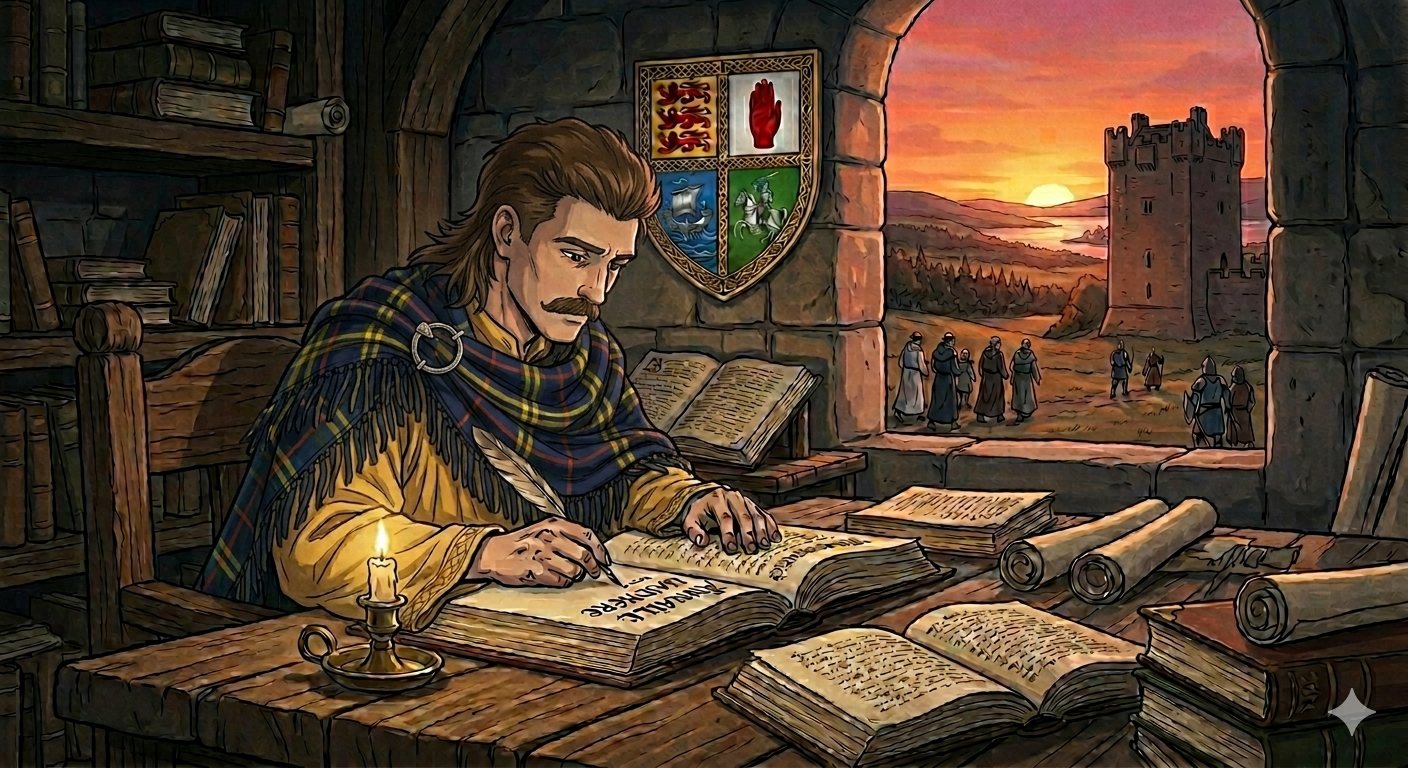
Annals of Ulster (University College Cork CELT Project)
Annals of the Four Masters (Mícheál Ó Cléirigh.)
Brian G. Scott, The Maguires of Fermanagh (Ulster Local History Society)
Patrick J. Duffy, Fermanagh: History and Society (Geography Publications, 2004)
John O’Donovan’s Notes on Fermanagh in Ordnance Survey Letters (1834–36)
Clare Downham, Viking Kings of Britain and Ireland: The Dynasty of Ívarr to AD 1014
Sean Duffy, The Concise History of Ireland, Medieval Ireland: An Encyclopedia
O’Clery Book of Genealogies
The book of Ballymote
The books of Knockninny
A Fermanagh Story" by Father Peadar Livingstone (1969)
Clan Maguire: History of Clann Mac Uidhir
Irish Families: Their Names, Arms and Origins" by Edward MacLysaght
The Maguires of Fermanagh" (Library Ireland/Duffy’s Hibernian Magazine
From Kings to Warlords" by Katherine Simms
Julius Caesar:De Bello Gallico (for the Menapii in Gaul).
T.F. O'Rahilly:Early Irish History and Mythology (for the connection between the Manapi and the Fir Manach).
Francis John Byrne:Irish Kings and High-Kings (for the history of Airgíalla and the Ulaid).
Ptolemy’s Geographia: (The primary 2nd-century record of the Manapi in Ireland).
You-Tube Channell’s that helped this website links below they are a great source of Gealic history and culture.
.1 http://www.youtube.com/@Clans_Dynasties
.2 http://www.youtube.com/@IrishMedievalHistory
.3 http://www.youtube.com/@forasfeasa
We have our own You-Tube Channell which covers our Mythology, History, Culture, Heritage and Reenactments. The Channell also shows our Stone Masonry Workshop which is open to orders we specialize in Celtic, Norse and Germanic Artwork like Runes and Ogham alphabet with intricate knot work engravings that are great for Garden or Home décor and a free bottle of Mead with every purchase our homebrew Honey-Stone is a refreshing honey wine we show our brewing process and our Business account is on Instagram. The Stone Masonry Business Insta account and Clan You-Tube Channell are under the same name Caveman Graffiti. Link below please like and share and thank you for your support.
. http://www.youtube.com/@Caveman_Graffiti
Gelfine: Open to anyone able to prove lineage going back to Thomas Patrick McManus 1954-Living. Gelfine members are on the Council Board of the Clan McManus\House of Magnhus CLG.
Derbfine; These are members who can prove a lineage from Thomas McManus 1918-1996 Derrylin Fermanagh Northern Ireland and are honouree kinsmen they are a part of the Council acting as support for Clan decisions and can also become Board members.
Iarfine; these are members who can prove a link back to Thomas McManus 1883-1945 Derrymacusey Northern Ireland Fermanagh, these are our welcomed McManus kinsmen who will always have a place within our society which celebrates us all.
Indfine; Shared Ancestry. These are members who can prove their ancestry from Patrick McManus Born 1770 Dublin, Ireland. Death:16 February 1837 County, Armagh, Northern Ireland. These members don’t have to carry the Clan surname. All who share the same lineage are recognized as Clan Members. Male and Female Lines of descent are recognized by the Tuatha.
· AICME REGISTRATION (CLAN ADOPTEES)
Statutory Designation: Social/Affiliate Members (Adoptee of the Tuatha)
This photo is of Thomas Patrick McManus and his brother Martin McManus with their parent’s Thomas McManus 1918-1997 and Anne Martin 1934-1991 in the Clan Heartland of Fermanagh Knockninny early 1950s.
Anne Martin’s lineage can be traced backed to many royale and noble dynasties of Europe. With a proven documentation on Ancestry.com with files going back to Sir George Farewell 1579-1647 and Lady Mary Seymour 1580-1660. Margaret Farewell 1614-1670 was the daughter of Sir George and Mary, Margaret Farewell married John Relfe 1605-1654. James Relfe 1687-1724 was the great grandson of John Relfe 1605-1654 and James’s daughter Susanne Relfe 1717-1765 married Thomas Palmer 1714-1777. Anne Palmer 1773-Death unknown was the granddaughter of Thomas Palmer 1714-1777, and she married James McGovern 1773-1831. Mary Anne McGovern 1857-1921 was the granddaughter of James McGovern 1773-1831. Susane Blake birthyear unknown-1957 was the granddaughter of Mary Anne McGovern 1857-1921, Susane Blake married Patrick Martin 1896-1948, Patrick is Anne Martins father. Lady Mary Seymour 1580-1660 was the Great granddaughter of Edward Seymour Duke of Sommerset 1500-1552 from him we trace it back to Dame Margery Wentworth 1478-1550 and from her to Henry (Hot Spur) Percy 1364-1403 he famously died at the Battle of Shrewsbury. From Henry (Hot Spur) Percy 1364-1403 we trace it back to Edmund Mortimer 3rd Earl of March 1352-1382 and Philippa 5th Countess of Ulster 1355-1382, from her to Lionel of Antwerp 1338-1368 who was the second born son to Edward 3rd of England 1312-1377. Lionel of Antwerp’s Wife Elizibeth De Burgh 4th Countess of Ulster 1332-1363 was descended from the De Burgh Earls and Barons of Connacht and Ulster. Lionel of Antwerp 1338-1368 was also the great grandson of King Philip 4th of France 1268-1314. Elizibeth 4th Countess of Ulster 1332-1363 was the granddaughter of Elizibeth De Clare 1295-1360 who was herself the great granddaughter of Isobel Marshal 1200-1240, Isobel was the daughter of Sir William Marshal 1146-1219 he was a renowned knight of his time and he married Isobel De Clare 4th Countess of Pembroke 1172-1220 and daughter of Richard Strongbow De Clare 1130-1176 who was one of the first Cambro-Norman Lords to come in the Norman invasion of Ireland. Through King Philip 4th of France 1268-1314 we can traced our lineage back to Henry 1st of France 1008-1060 who married Anne of Kiev 1030-1075, Anne of Kiev was the daughter of Yaroslav the Wise 978-1054 he was Grand prince of Kiev. Anne of Kiev was also the daughter of Ingegerd Olafsdotter 1001-1050. Ingegerd Olafsdotter was the granddaughter of the famous last Pagan Viking King of Sweden Eric the Victorious 945-995. Through Edward 3rd of England 1312-1377 we can trace it back to Geofrey of Anjou 1113-1151 and Empress Matilda 1102-1167, Empress Matilda was the daughter of Henry 1st of England 1068-1135 and granddaughter of William the Conqueror 1028-1087. Empress Matilda was also the daughter of Matilda of Scotland 1080-1118. Matilda of Scotland was the daughter of Malcolm 3rd of Scotland 1031-1093 and Saint Margeret of Scotland 1045-1093. Saint Margeret of Scotland was the daughter of Edward the Exile 1016-1057; Edward the Exile was the son of Edmund Ironside King of Anglo-Saxon England 991-1016. Through the De Burgh family with their founder William De Burgh 1160-1206 married an O’Brien Princess linking them with the King’s of Thomond, Limerick, Munster and the O’Brien High King’s of Ireland and even Brian Buro himself. Geoffrey of Anjou 1113-1151 was the son of Falk 5th Count of Anjou 1089-1143; Falk was also King of Jerusalem from 1131 to 1143. Henry 1st of France 1008-1060 was the Great grandson of Hedwig 910-958; she was the daughter of Henry (The Fowler) King of East Frankia 876-936. Yaroslav the Wise 978-1054 was the great grandson of Saint Olga of Kiev 890-969. Hedwig 910-958 was the wife of Hugh Capet 898-956 who was the son of Beatrice Carolingian 880-931. From Beatrice Carolingian 880-931 we can trace it back to Emperor Charlamagne 748-814, Charlamagne was the grandson of Charles Martel 688-741. Charles Martel is famed for the battle of Tours where he defeated the Umayyad Caliphate. Charles Martel 699-741 was a direct male descendant of Saint Arnulf of Metz 582-647.
Anne Martin’s ancestry represents an extraordinary consolidation of Western history. Through documented preservation, her family tree serves as a living chronicle of Europe—uniting the Anglo-Saxon and Norman crowns of England, the High Kings of Ireland, the early Tsars of Russia, the Carolingian emperors, and the foundational monarchs of France and Scotland.
The study of genealogy reveals a profound truth about human interconnectedness: if one travels sufficiently far back in time, all individuals share a common ancestry. In the context of genealogical research, this reality is often unlocked by a "Gateway Ancestor"—an individual whose lineage is historically documented, thereby connecting modern descendants to ancient, noble, and royal houses. While every human being inherently possesses such foundational ancestors, the passage of time and the loss of historical records mean that only some families possess the verified documentation required to prove it. For the Martin family, this bridge to antiquity is fully illuminated.
The Clan McManus\House of Magnhus CLG Coat of Arms captures the Clans lineage beautifully our two Irish Wolfhound supporters showing our Gealic Royale connection to the Maguires then our shield shows our ancestry with the Maguire represented in the bottom right and in the top right is our link to the De Burgh Earldom of Ulster but instead of Red Hand on Gold Field we have a Red Hand on a Silver Field, then in the top left is our Angevin connection with the colours reversed keeping with heraldic law and finally we have us the McManus Clan represented in bottom left with our Irish Galley showing our navel prowess.
After membership registration you will have access to the Clan WhatsApp group where all members will be informed about upcoming events and gatherings.
To live as a McManus is to carry a legacy of strength that is measured not by what we take, but by what we give. Our philosophy is a circle of protection—extending from the land beneath our feet to the neighbours by our side.
The McManus Clan Creed.
I. Charity: The Heart of the Clan
We believe that true prosperity is only realized when it is shared. To a McManus, charity is not an afterthought; it is a duty. We reach out to those in need not out of pity, but out of the understanding that we are all part of one story. When one of us rises, we reach back to pull another up.
II. Stewardship: Caring for the land and animals we share it with.
The land is our silent ancestor. We recognize that we do not own the environment; we borrow it and by caring for our natural world, we honour the roots that sustain us and ensure that the air, water, and soil remain vibrant for the generations of the Clan yet to be born.
III. Community: Taking Care of Our Own
A McManus never stands alone. We are the architects of a community built on radical kindness and unwavering support. We celebrate each other’s victories and shoulder each other’s burdens. Our bond is our greatest fortress.
IV. Vitality: Strength in Body and Spirit
We honour our lineage by keeping ourselves sharp, capable, and physically healthy. A strong body is the vessel for a strong mind and a resilient spirit. We stay fit so that we are always ready, ensuring we have the energy to serve our family and our mission.
V. Justice: Defending the innocent.
The McManus spirit is defined by courage. We stand as a shield for those who cannot defend themselves. We use our strength to confront injustice and our voices to speak for the silenced. To be McManus is to be a protector—the one who stands firm when others turn away.
"In our hands, there is help. In our hearts, there is heat." Lamh Dearg Abu! "Vital in Spirit, Vigilant in Mercy."